Why Generic Cloud Often Falls Short
Major cloud providers have built extraordinary platforms. They offer global scale, a vast catalogue of managed services, and pricing models that have transformed enterprise IT. For general-purpose workloads—web applications, data analytics, SaaS products—these platforms are difficult to fault.
But regulated life-sciences R&D is not a general-purpose workload. It operates under a distinct set of constraints that generic platforms were never designed to satisfy natively. These constraints are not optional nice-to-haves; they are regulatory obligations codified in frameworks such as EU GMP Annex 11, FDA 21 CFR Part 11, and ICH Q9.
The disconnect typically manifests not as a single dramatic failure, but as a persistent accumulation of friction. Compliance teams spend weeks translating provider-agnostic SOC 2 reports into evidence that maps to GxP requirements. Validation engineers discover that the provider's change management cadence—continuous deployment with rolling updates—conflicts with their change control procedures. IT operations find that the provider's shared responsibility model leaves ambiguity about who owns the audit trail for infrastructure-level events.
The problem is rarely that generic cloud is insecure. The problem is that the evidence model—the way security and integrity are demonstrated—does not align with what regulators expect.
Where the Bottlenecks Actually Appear
When life-sciences organisations deploy regulated workloads on generic cloud infrastructure, the bottlenecks tend to cluster in four areas. Understanding these patterns is essential for evaluating whether purpose-built infrastructure is warranted.
Storage Architecture
Genomic datasets, imaging data, and molecular simulation outputs generate files measured in terabytes. Generic cloud storage tiers optimise for cost per gigabyte, but regulated workloads also require guaranteed IOPS for computational pipelines, immutable audit trails for every access event, and retention policies that satisfy both data protection and regulatory archival requirements simultaneously. Object storage with eventual consistency—the default in most cloud platforms—can create complications for workflows that require strong read-after-write consistency to maintain data integrity.
Network Design
In a shared cloud environment, network bandwidth is a pooled resource. For interactive computational workloads—real-time visualisation of protein structures, distributed training of AI models across GPU nodes—network latency and jitter directly affect scientific outcomes. Purpose-built infrastructure uses dedicated network fabrics with guaranteed bandwidth allocations, eliminating the variability that shared network overlays introduce.
Identity and Access Management
Cloud-native IAM systems are designed for flexibility: hundreds of services, thousands of permission combinations, dynamic role assumptions. In a GxP context, this flexibility becomes a liability. Auditors expect to see a concise, reviewable access control matrix where every permission can be justified. Purpose-built platforms implement IAM that is scoped to the specific services and roles required by regulated workflows, reducing the attack surface and simplifying access reviews.
Evidence Generation
Perhaps the most significant bottleneck is evidence. Generic platforms generate enormous volumes of logs, metrics, and events. The challenge is not a lack of data but an excess of it, with no inherent structure mapping to regulatory requirements. Compliance teams must build custom pipelines to extract, transform, and present evidence in formats that auditors understand. Purpose-built infrastructure generates evidence that is structured for regulatory consumption from the outset—audit trails that map directly to Annex 11 requirements, change logs that align with quality management system expectations, and performance records that support validation protocols.
What "Audit-Ready" Looks Like Operationally
The term "audit-ready" is used frequently in vendor marketing, but its operational meaning is specific and demanding. An audit-ready infrastructure platform must be able to produce, within hours rather than weeks, a complete set of evidence covering the following domains.
- System inventory: A current, accurate record of all hardware and software components, their versions, and their configuration states.
- Access control evidence: A complete history of who had access to what, when access was granted or revoked, and the authorisation chain for each decision.
- Change history: Every change to the infrastructure—hardware replacements, firmware updates, configuration modifications—documented with timestamps, responsible parties, and impact assessments.
- Performance baselines: Continuous records demonstrating that the infrastructure has operated within validated performance parameters throughout the period under review.
- Incident records: Documentation of every incident, including root-cause analysis, corrective actions, and effectiveness checks.
Generic cloud providers can produce much of this information, but it typically requires significant effort to compile, cross-reference, and present in a format that satisfies regulatory expectations. Purpose-built infrastructure generates this evidence as a byproduct of normal operations, not as an afterthought.
Tiered Platform Roadmaps: Reducing Transition Risk
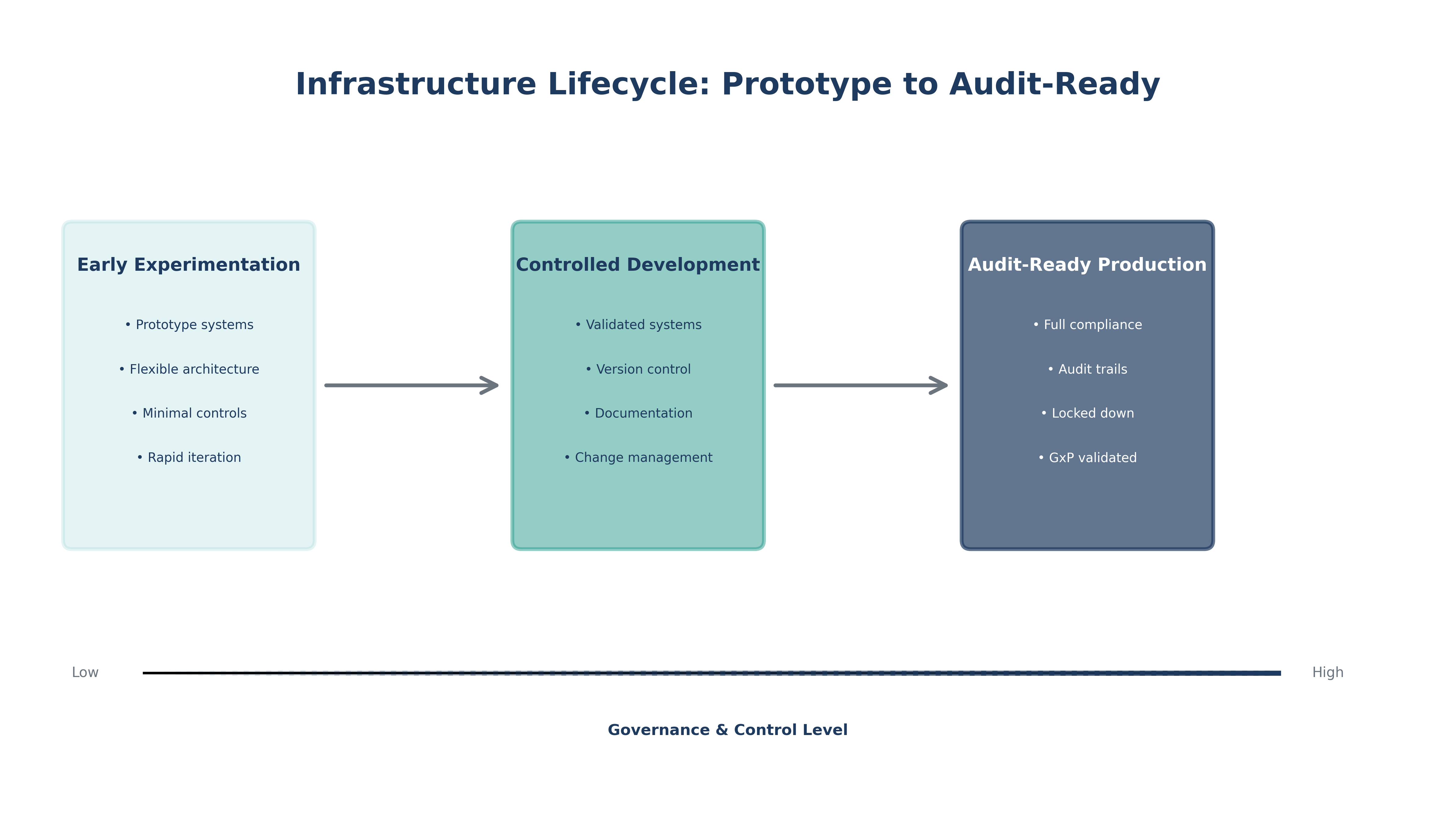
One of the practical advantages of purpose-built infrastructure is the ability to define a staged adoption path that aligns with organisational maturity and regulatory requirements. A tiered platform roadmap—structured as progressive capability levels from foundational compute (P-01) through to full compliance oversight (P-04)—allows organisations to begin with essential infrastructure and expand capabilities as their needs evolve.
This approach directly addresses one of the most common and costly problems in regulated infrastructure: the mid-programme re-platform. When an organisation starts on a generic platform and later discovers that it cannot meet regulatory requirements, the resulting migration is expensive, risky, and disruptive to ongoing research programmes. A tiered, purpose-built platform eliminates this risk by ensuring that every tier is designed with the full regulatory endpoint in mind.
| Tier | Capability | Regulatory Alignment |
|---|---|---|
| P-01: Core Compute | Dedicated compute, storage, and network with baseline monitoring | Infrastructure qualification, asset inventory, backup verification |
| P-02: Research Platform | Managed data services, workflow orchestration, collaboration tools | Access controls, audit trails, data integrity controls |
| P-03: AI Workflow Engine | GPU clusters, model training pipelines, experiment tracking | Validation protocols, reproducibility evidence, model governance |
| P-04: Compliance & Oversight | Automated compliance reporting, continuous monitoring, regulatory dashboards | Full Annex 11 lifecycle management, periodic review automation |
Each tier builds on the one below it, and crucially, the compliance architecture is consistent across all tiers. An organisation operating at P-01 uses the same audit trail format, the same access control model, and the same change management process as one operating at P-04. The only difference is the breadth of capabilities exposed.
EU GMP Annex 11 and Lifecycle Risk Management
EU GMP Annex 11 establishes expectations for computerised systems used in GxP-regulated activities. Its requirements are not limited to application software; they extend explicitly to the infrastructure on which that software operates. Key expectations include risk management throughout the system lifecycle, formal change control procedures, data integrity measures including audit trails, and periodic review of validated systems.
Purpose-built infrastructure addresses these expectations architecturally rather than procedurally. Instead of bolting compliance controls onto a generic platform through additional layers of tooling and process, the controls are embedded in the infrastructure design itself. Change management is enforced by the platform, not just documented in an SOP. Audit trails are generated automatically, not assembled retrospectively from disparate log sources. Risk assessments reference a known, stable architecture rather than a continuously evolving set of managed services.
This architectural approach to compliance is not merely more efficient—it is more robust. It reduces the risk of human error in compliance processes and provides a stronger foundation for regulatory defence.
Purpose-built infrastructure is not about limiting capability—it is about eliminating the false choice between performance and compliance. When the platform is designed for regulated workloads from the ground up, organisations get both: the computational power their science demands and the compliance posture their regulators require, without compromise in either direction.
References & Further Reading
- EU GMP Annex 11: Computerised Systems European Commission guidance on lifecycle risk management, validation, supplier oversight, audit trails, and security for computerised systems in GMP environments.
- NIST SP 800-145: The NIST Definition of Cloud Computing Formal definition of cloud computing characteristics including resource pooling and multi-tenancy — useful language for procurement discussions.
- Hidden Technical Debt in Machine Learning Systems Seminal NeurIPS paper explaining why ML systems accrue hidden maintenance costs and why platformisation matters at scale.
- Cloud Security Alliance: Security Guidance Vendor-neutral guidance on tenancy controls, shared responsibility models, and cloud security architecture.