What Is Resource Pooling, Really?
The NIST definition of cloud computing identifies five essential characteristics, and resource pooling sits at the centre. In plain language, resource pooling means that a provider's compute, storage, and network capacity is shared across multiple customers using a multi-tenant model. Physical and virtual resources are dynamically assigned and reassigned according to demand. The customer generally has no control—or even awareness—of the exact location of the resources they consume, although they may be able to specify a region or availability zone.
For general-purpose IT workloads this model works exceptionally well. It drives cost efficiency through economies of scale and allows organisations to scale capacity without capital expenditure. However, for regulated life-sciences R&D—where data integrity, reproducibility, and audit trails are non-negotiable—multi-tenancy introduces a set of risks that must be explicitly addressed.
Performance Predictability vs Elasticity
The fundamental tension between dedicated and shared compute can be stated simply: elasticity comes at the cost of predictability. In a shared environment, your workload contends with other tenants for CPU cycles, memory bandwidth, network throughput, and storage IOPS. During periods of high demand across the platform, your workload may experience degraded performance—the so-called "noisy neighbour" problem.
For many workloads this variability is acceptable. For regulated computational workflows—molecular dynamics simulations, large-scale genomic analyses, or AI model training runs that must be reproducible—it is not. A simulation that takes fourteen hours on Monday and nineteen hours on Thursday, with no change to input parameters, raises questions about data integrity that are difficult to answer in an audit context.
Reproducibility is not just a scientific concern. In a GxP context, it is a data integrity requirement. If your infrastructure cannot demonstrate consistent performance characteristics, your validation evidence is weakened from the start.
Dedicated compute eliminates this variable entirely. When hardware is allocated exclusively to your organisation, performance characteristics are deterministic. Benchmarks produce consistent results. Validation protocols can reference stable baselines. The compliance narrative becomes straightforward.
Mapping Risks to Controls
Understanding the risk landscape requires looking beyond performance. Three categories of risk deserve particular attention when evaluating shared versus dedicated infrastructure for regulated workloads.
Cross-Tenant Data Exposure
In a multi-tenant environment, logical isolation separates tenants at the software layer. While hypervisor-level isolation is generally robust, the risk surface is broader than many organisations appreciate. Shared storage arrays, network fabrics, and caching layers all present potential vectors for data leakage. Side-channel attacks—though rare in practice—have been demonstrated in academic settings against shared cloud infrastructure.
For organisations handling pre-clinical data, proprietary compound structures, or patient-derived datasets, the risk calculus shifts. The question is not whether a breach is likely, but whether you can demonstrate to a regulator that adequate controls exist. With dedicated infrastructure, the control narrative is simple: there are no other tenants.
Audit Narrative Complexity
Auditors expect clear, traceable evidence that data has been handled in accordance with applicable regulations. In a shared environment, this evidence chain depends on the provider's multi-tenancy controls, which your organisation does not directly govern. You are relying on third-party attestations—SOC 2 reports, ISO 27001 certificates—that describe controls in general terms rather than demonstrating their specific application to your data.
With dedicated infrastructure, the boundary is unambiguous. Your audit evidence references hardware that is exclusively allocated to your organisation, managed under your policies, and observable through your own monitoring. This simplifies every conversation with auditors and regulators.
Noisy Neighbour Effects
Beyond the performance implications already discussed, noisy neighbour effects can impact availability. If a co-tenant's runaway process saturates shared network bandwidth or triggers resource throttling at the hypervisor level, your workloads are affected. In a regulated context, unplanned availability interruptions require documented investigation and root-cause analysis—a burden that is difficult to discharge when the root cause lies in another tenant's activity that you cannot observe.
Decision Table: Dedicated vs Shared
The following table summarises the core trade-offs across the dimensions that matter most for regulated life-sciences organisations.
| Dimension | Dedicated | Shared / Multi-Tenant |
|---|---|---|
| Core Trade-Off | Higher unit cost, full control | Lower unit cost, shared control |
| Risk Profile | Isolated by design; minimal cross-tenant exposure | Logical isolation; residual cross-tenant risk surface |
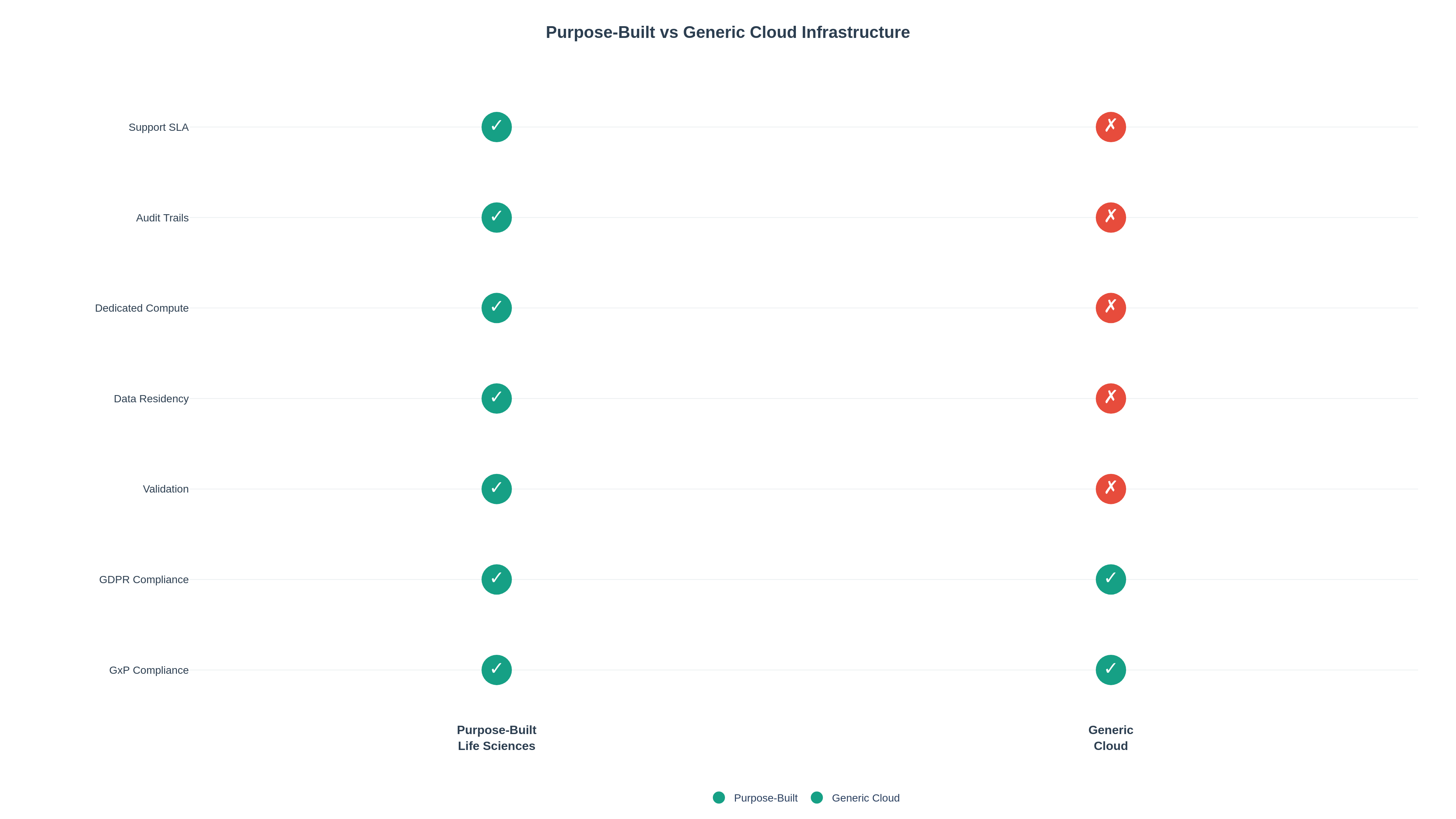
| Compliance Evidence | Direct, observable, self-contained | Dependent on provider attestations and shared responsibility models |
| Performance | Deterministic; consistent benchmarks | Variable; subject to noisy-neighbour effects |
| Typical Failure Mode | Over-provisioning (excess capacity during low demand) | Under-performance during contention; audit evidence gaps |
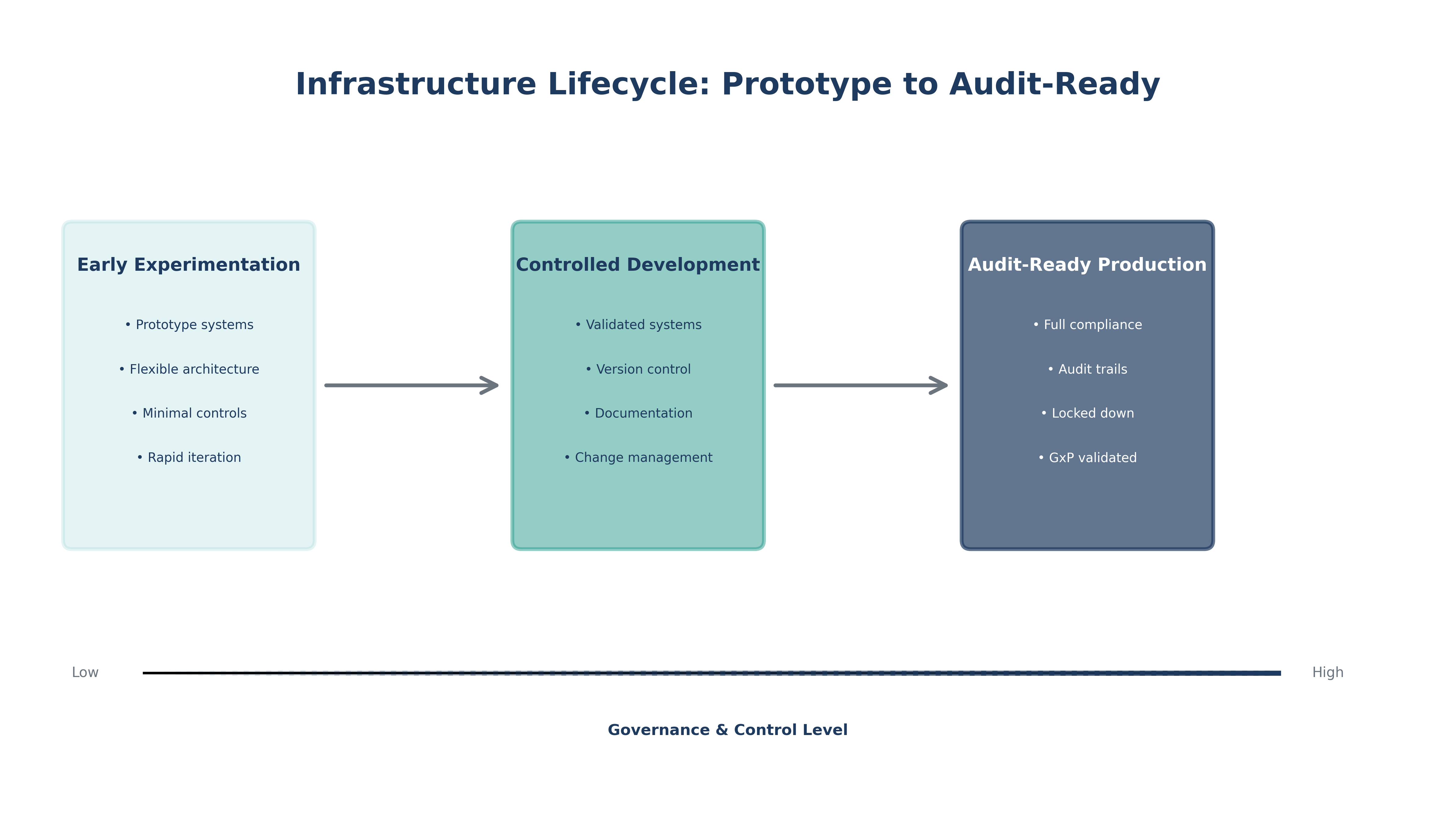
| When It Fits Best | GxP workloads, sensitive IP, reproducible computational science, audit-intensive environments | Non-regulated exploration, early prototyping, burst workloads with low data sensitivity |
Neither model is universally superior. The right choice depends on the regulatory context, the sensitivity of the data, and the maturity of the organisation's quality management system. What matters is that the decision is made deliberately and documented as part of the infrastructure qualification process.
Procurement Checklist
When evaluating any infrastructure provider—whether for dedicated or shared compute—the following questions should be part of your procurement and vendor qualification process.
- Tenant isolation architecture: How are tenants separated at the compute, storage, and network layers? Is isolation enforced at the hardware level, the hypervisor level, or purely in software?
- Performance guarantees: Does the provider offer contractual SLAs for compute performance (not just availability)? Can you obtain dedicated IOPS, bandwidth, and CPU allocations?
- Audit access: Can your quality team or auditors inspect the infrastructure? Are logs available in a format compatible with your SIEM or audit trail systems?
- Data residency and sovereignty: Where is data physically stored? Can the provider guarantee that data does not leave a specified jurisdiction, including for backups and disaster recovery?
- Change management transparency: How are infrastructure changes (firmware updates, hypervisor patches, hardware replacements) communicated and documented? Do you receive advance notice?
- Incident response: What is the provider's incident notification timeline? Do they share root-cause analyses for incidents affecting your environment?
- Decommissioning and data destruction: What processes govern the secure erasure of data when hardware is decommissioned or reallocated? Can you obtain certificates of destruction?
- Regulatory awareness: Does the provider have demonstrable experience with GxP, EU GMP Annex 11, or FDA 21 CFR Part 11 requirements? Can they provide reference customers in regulated life sciences?
These questions are not exhaustive, but they establish whether a provider understands the regulatory context in which your organisation operates. A provider that cannot answer them clearly is unlikely to be a suitable partner for regulated workloads.
The Compliance Evidence Narrative
Ultimately, the choice between dedicated and shared compute shapes the story you tell auditors and regulators about how data integrity is maintained. With shared infrastructure, that story necessarily includes caveats: "We rely on the provider's multi-tenancy controls, which are attested by their SOC 2 Type II report, and we have reviewed their shared responsibility matrix." Each caveat is a point where an auditor may probe further.
With dedicated infrastructure, the story is simpler and more direct: "This hardware is exclusively allocated to our organisation. We control access, we monitor performance, and we maintain the audit trail." Simplicity in compliance narratives is not a luxury—it is a strategic advantage that reduces audit friction and accelerates regulatory interactions.
Dedicated infrastructure does not merely reduce risk—it simplifies the compliance evidence narrative. When hardware is exclusively allocated, every audit question about tenant isolation, performance variability, and data co-residency has a one-sentence answer. That simplicity translates directly into faster audits, fewer findings, and stronger regulatory confidence.
For organisations at the intersection of computational science and regulatory obligation, infrastructure decisions are not just technical choices. They are compliance decisions, and they deserve the same rigour as any other element of your quality management system.
References & Further Reading
- EU GMP Annex 11: Computerised Systems European Commission guidance on lifecycle risk management, validation, supplier oversight, audit trails, and security for computerised systems in GMP environments.
- NIST SP 800-145: The NIST Definition of Cloud Computing Formal definition of cloud computing characteristics including resource pooling and multi-tenancy — useful language for procurement discussions.
- Hidden Technical Debt in Machine Learning Systems Seminal NeurIPS paper explaining why ML systems accrue hidden maintenance costs and why platformisation matters at scale.
- Cloud Security Alliance: Security Guidance Vendor-neutral guidance on tenancy controls, shared responsibility models, and cloud security architecture.