What You Truly Own Either Way
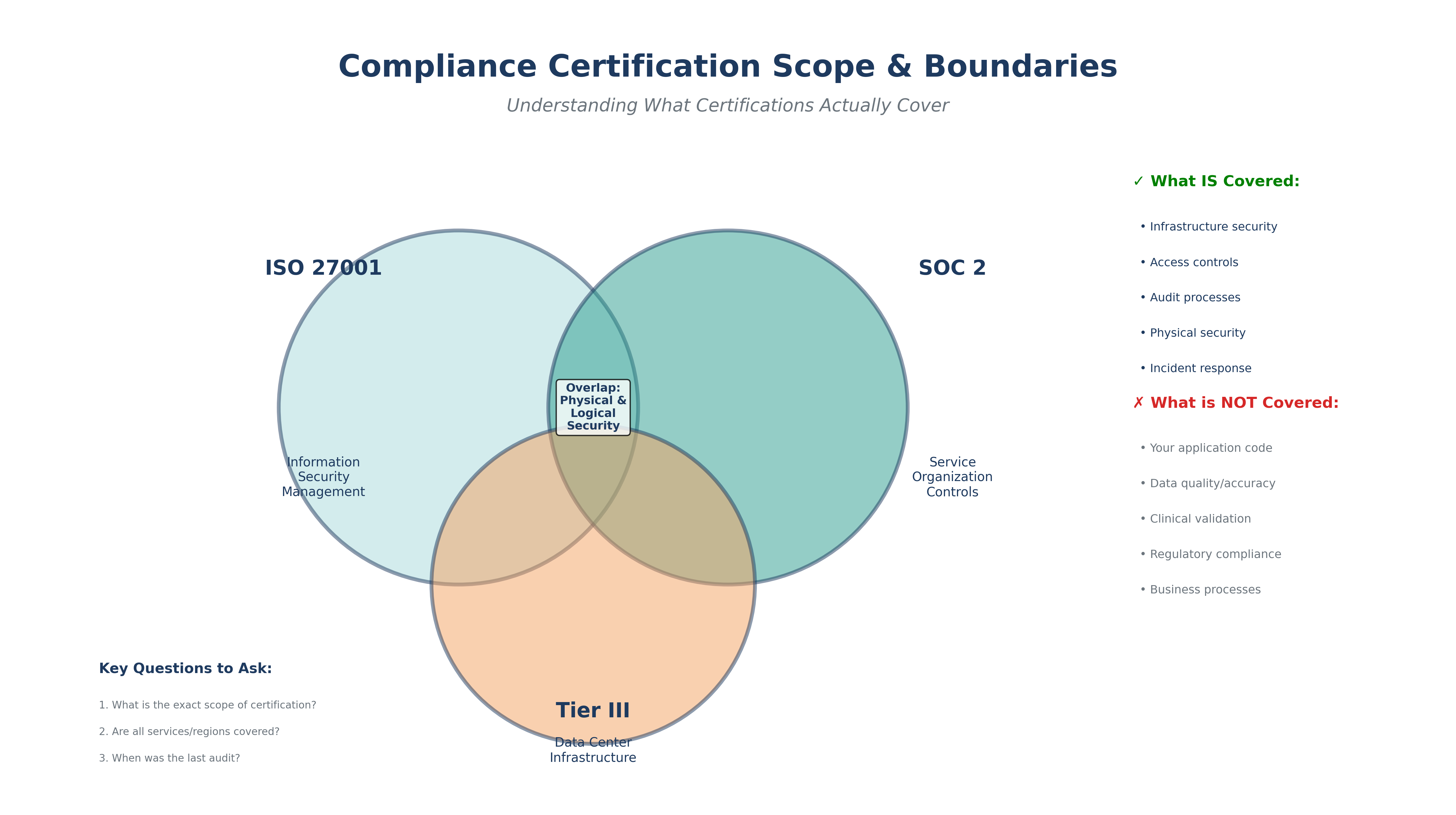
Build or buy, the accountability for regulatory outcomes rests with your organisation. No vendor contract transfers the obligation to demonstrate data integrity, model reproducibility, or audit readiness. Whether your AI platform runs on infrastructure you assembled in-house or on a validated third-party stack, three things remain irrevocably yours: your data, your decisions, and your accountability.
This is a critical framing point for board-level discussions. Executives sometimes assume that buying a platform also buys compliance. It does not. A vendor can provide the controls, the documentation framework, and the operational baseline—but the regulated entity is still the one standing in front of the auditor. Conversely, building in-house does not inherently grant more control; it grants more responsibility, which is not the same thing.
The question is not whether you own the outcome—you always do. The question is how efficiently and sustainably you can produce the evidence that demonstrates that ownership.
Evidence and Operations: The Hidden Cost Centre
When leadership teams model the cost of an AI platform, the initial calculus tends to focus on hardware, software licences, and headcount. These are visible, budgetable line items. What consistently surprises organisations—particularly those new to regulated AI—is the cost of everything that surrounds the platform: the evidence lifecycle, the operational discipline, and the governance overhead.
Evidence is not a one-time deliverable. Every model deployed in a regulated context requires validation documentation, change-control records, performance monitoring logs, and periodic requalification. Each of these artefacts must be version-controlled, reviewable, and audit-ready at any moment. The effort to maintain this corpus grows with every model, every dataset, and every infrastructure change.
The most expensive line item in a regulated AI programme is rarely compute. It is the ongoing cost of proving that everything works as documented, every day, to every auditor who asks.
Operations compound this challenge. A platform that runs well during a proof-of-concept may become a governance liability at scale if patching cadences slip, monitoring gaps emerge, or incident response procedures are not formalised. These are not hypothetical risks—they are the patterns that surface in every audit of immature AI operations.
Cost Drivers: Build vs Buy
The following table maps the primary cost drivers in a regulated AI platform decision, highlighting where hidden costs tend to accumulate and how to manage them.
| Cost Driver | What It Includes | Why It Surprises Teams | How to Control It |
|---|---|---|---|
| CapEx vs OpEx | Hardware procurement, datacentre space, power, cooling (build) vs subscription or consumption fees (buy) | Build CapEx is front-loaded but OpEx for maintenance, upgrades, and end-of-life hardware is ongoing and often unbudgeted | Model total cost of ownership over 5 years, including refresh cycles and decommissioning costs |
| Compliance Evidence | Validation protocols, IQ/OQ/PQ documentation, change-control records, audit trail systems | Evidence generation is continuous, not a one-time project; each platform change triggers revalidation effort | Adopt a validation framework that supports incremental qualification rather than full revalidation on every change |
| Operations | 24/7 monitoring, incident response, patching, backup verification, capacity planning | Operational maturity requires dedicated staff with both infrastructure and regulatory expertise—a rare and expensive combination | Define SLAs early; benchmark internal operational cost against managed-service alternatives |
| Toolchain Maintenance | ML frameworks, orchestration tools, experiment tracking, CI/CD pipelines, container registries | Open-source tools are free to adopt but expensive to integrate, secure, and keep compatible across versions | Standardise on a curated toolchain; resist the temptation to adopt every new framework that emerges |
| Data Governance | Access controls, lineage tracking, classification, retention policies, cross-border transfer compliance | Governance requirements scale non-linearly with data volume and the number of teams consuming the platform | Implement governance tooling from day one; retrofitting governance onto an established platform is significantly more costly |
Decision Criteria: Timeline, Compliance Scope, and Risk Tolerance
The build-vs-buy decision is not purely financial. Three dimensions consistently determine which path is more appropriate for a given organisation at a given point in its maturity.
Timeline
Building a regulated AI platform from components takes time—typically 12 to 18 months before the first production workload runs in a validated state. If your organisation needs to demonstrate AI capability to regulators, partners, or investors within six months, buying a validated platform and configuring it to your requirements is the pragmatic choice. Time-to-compliance is as important as time-to-market.
Compliance Scope
The breadth of your regulatory obligations matters. If your workloads fall under a single regulatory framework—say, GxP for pharmaceutical R&D—the compliance requirements are well understood and a specialist vendor may already have the evidence packages prepared. If you operate across multiple jurisdictions and frameworks (EU MDR, FDA, PDPA, GDPR), the compliance surface area expands dramatically. Building in-house gives you the flexibility to tailor controls, but that flexibility comes with the obligation to design, implement, and maintain those controls yourself.
Risk Tolerance
Organisations with low risk tolerance and high audit frequency benefit from the predictability of a managed, pre-validated platform. Organisations with strong internal engineering and quality teams may prefer the control that comes with building—provided they are prepared to sustain the operational commitment indefinitely. The worst outcome is building a platform with the ambition of a technology company but funding it with the budget of a science department.
What "Dedicated and Validated" Changes in Procurement
The phrase "dedicated and validated" has become common in vendor marketing, but its meaning in procurement terms is specific and consequential. Dedicated means that the infrastructure serving your organisation is not shared with other tenants—at the hardware level, not merely at the logical or software level. Validated means that the platform has been qualified through a documented process (typically IQ/OQ/PQ) that produces evidence acceptable to regulators.
When evaluating vendors, procurement teams should ask for the validation master plan, not just the marketing collateral. They should request sample qualification protocols and review them with their quality assurance team. They should verify that "dedicated" means physically isolated infrastructure, not a dedicated virtual partition on shared hardware. And they should confirm that the vendor's change-management process includes customer notification and impact assessment—because a vendor-initiated change to a validated platform triggers your own change-control obligations.
These distinctions matter because they determine the strength of the compliance narrative your organisation can present. A platform that is genuinely dedicated and validated simplifies audit preparation, reduces the volume of risk-acceptance documentation required, and shortens the path from procurement to productive use.
The real cost of AI platforms is not hardware—it is evidence, operations, and governance. Whether you build or buy, these costs are unavoidable. The strategic question is whether your organisation is better served by investing in the capability to produce and maintain compliance evidence internally, or by leveraging a partner whose operational model is designed around that obligation from the start.
Board-level decision-makers do not need to understand the technical details of GPU clusters or container orchestration. They need to understand that the platform cost they see in a proposal represents a fraction of the total commitment, and that the sustainability of a regulated AI programme depends on the operational and governance foundations beneath it. Build or buy, those foundations must be funded, staffed, and maintained for the life of the programme.
References & Further Reading
- ISO/IEC 27001: Information Security Management Systems International standard defining requirements for establishing, implementing, and maintaining an ISMS.
- Uptime Institute: Data Centre Tier Classification Defines Tier III as concurrently maintainable with redundant components and distribution paths.
- AICPA: SOC 2 — Trust Services Criteria Defines SOC 2 as a report on controls relevant to security, availability, processing integrity, confidentiality, and privacy.
- Hidden Technical Debt in Machine Learning Systems Explains why "buying a platform" can be lower-risk than building ad hoc — dependency drift, tool sprawl, and ownership gaps.