The Year-One Illusion
The first year of an AI platform deployment is, by nearly every visible metric, a success. Models are trained. Predictions are generated. Stakeholders see results. The team that built the platform is lauded for delivering on an ambitious timeline, and the organisation begins planning how to scale what it has built.
Then year two arrives, and a different set of problems emerges. The platform that ran smoothly with two models and one team begins to strain under five models and three teams. Dependencies that were trivially managed during the proof-of-concept become entangled and fragile. The engineer who understood the entire stack has moved on, and the documentation they left behind is incomplete. Operations that were handled manually—"just this once"—have become permanent workarounds that no one wants to formalise or automate.
This is not a technology failure. It is a debt pattern—the accumulation of deferred decisions about governance, operations, and ownership that compounds until the platform becomes more expensive to maintain than it was to build.
What Technical Debt Looks Like in ML Systems
The concept of technical debt is well established in software engineering, but ML systems introduce debt categories that traditional software does not face. A landmark paper from Google researchers, "Hidden Technical Debt in Machine Learning Systems," identified several of these categories, and the patterns it described remain acutely relevant for regulated AI platforms.
Dependency Drift
ML systems depend on external data, upstream models, feature pipelines, and third-party libraries in ways that are difficult to track and harder to stabilise. A model trained on data from a particular source may silently degrade when that source changes its format, its sampling methodology, or its update cadence. A library upgrade that improves performance for one model may break compatibility for another. In a regulated context, every dependency change is potentially a change-control event—but if dependencies are not explicitly tracked, the change happens without the corresponding governance.
Tool Sprawl
In the first year, teams adopt tools rapidly to solve immediate problems. Experiment tracking with one framework. Model serving with another. Data versioning with a third. Pipeline orchestration with a fourth. Each tool solves a real problem, but collectively they create an integration surface that grows in complexity with every addition. By year two, the platform is not a platform at all—it is a loosely coupled collection of tools held together by custom scripts and institutional knowledge.
Tool sprawl is not a sign of poor planning. It is the natural consequence of optimising for speed in year one without accounting for maintainability in year two.
Unclear Ownership
Who owns the feature pipeline? Who is responsible for model monitoring in production? Who decides when a model should be retrained, and who validates the retrained model before deployment? In year one, these questions have informal answers—usually "the person who built it." In year two, when that person is working on something else or has left the organisation, the informal answers become operational gaps. In regulated environments, these gaps are not merely inconvenient—they represent compliance risks that auditors will identify.
How Tool Sprawl and Ownership Gaps Compound
The interaction between tool sprawl and unclear ownership creates a particularly destructive dynamic. When multiple tools serve overlapping functions and no single team owns the integration layer, three things happen simultaneously.
First, monitoring becomes fragmented. Each tool has its own logging and alerting mechanisms, but no single view of platform health exists. An anomaly that manifests across multiple tools goes undetected because no one is responsible for correlating signals across the toolchain.
Second, change management becomes impossible. Upgrading one tool requires understanding its interactions with every other tool in the stack. Without clear ownership and documented interfaces, teams default to not upgrading—which introduces security vulnerabilities and compatibility risks that accumulate silently.
Third, onboarding becomes a bottleneck. New team members face a learning curve that scales with the number of tools, the complexity of their integration, and the absence of documentation. The platform's throughput becomes constrained not by compute capacity but by the number of people who understand how it works.
Platform Standardisation as Prevention
The antidote to the hidden debt pattern is not better tools—it is platform standardisation. A standardised platform defines a curated set of tools, a consistent set of interfaces, and a clear operational model before the first workload is deployed. It trades some of year one's speed for year two's sustainability.
Standardisation does not mean rigidity. It means establishing clear boundaries around what is supported, how components interact, and who is responsible for each layer of the stack. Within those boundaries, research teams retain the flexibility to experiment with models, datasets, and methodologies. Outside those boundaries, changes go through a governed process that assesses impact, documents rationale, and maintains the audit trail.
In practice, platform standardisation includes several concrete commitments.
- A defined toolchain with version-pinned dependencies, tested upgrade paths, and documented compatibility matrices
- A shared data layer with consistent access controls, lineage tracking, and retention policies
- A deployment pipeline that enforces validation gates before any model reaches production
- An operational baseline that defines monitoring, alerting, backup, and incident-response procedures
- An ownership model that assigns accountability for every component, with named individuals and documented escalation paths
These are not aspirational items for a future roadmap. They are prerequisites for a platform that will still be functional and compliant when the initial enthusiasm of year one gives way to the operational reality of year two.
Governance and Operations as Product Features
The most consequential shift in thinking for organisations building sustainable AI platforms is recognising that governance and operations are not afterthoughts—they are product features. In the same way that a model's accuracy is a feature, the platform's audit readiness is a feature. In the same way that inference speed is a feature, the platform's change-management process is a feature.
This reframing has practical implications for how platforms are funded and staffed. If governance is a product feature, it needs dedicated resources—not ad hoc effort borrowed from the research team when an audit is imminent. If operations is a product feature, it needs a team with both infrastructure expertise and regulatory awareness—not a single engineer who also happens to manage the Kubernetes cluster.
Organisations that treat governance and operations as first-class product features tend to exhibit common characteristics. They budget for compliance continuously rather than in annual surges before audits. They staff platform operations as a permanent function rather than a project role. They measure platform health in terms of operational metrics—mean time to detect, mean time to resolve, change-control cycle time—rather than only compute utilisation and model performance.
A platform that can train a model in four hours but takes four weeks to produce the evidence that the model is validated for production use has a product problem, not a technology problem.
The organisations that succeed in year two are those that understood in year one that they were not building a machine learning platform. They were building an operational capability—one that happens to include machine learning among its functions, but that depends equally on governance, documentation, monitoring, and change management for its long-term viability.
Sustainable AI platforms require treating governance and operations as first-class product features, not as overhead to be minimised. The hidden debt pattern—dependency drift, tool sprawl, and unclear ownership—is not inevitable. It is the predictable consequence of deferring operational and governance decisions that should be made at the outset. Platforms that invest in standardisation, clear ownership, and operational discipline from day one do not merely avoid year-two failure—they build the foundation for long-term, auditable, scalable AI capability.
Year one proves that AI works. Year two proves that the organisation can sustain it. The difference between the two is not more compute or better algorithms—it is the operational and governance infrastructure that most teams deprioritise until it is too late to build without disruption.
References & Further Reading
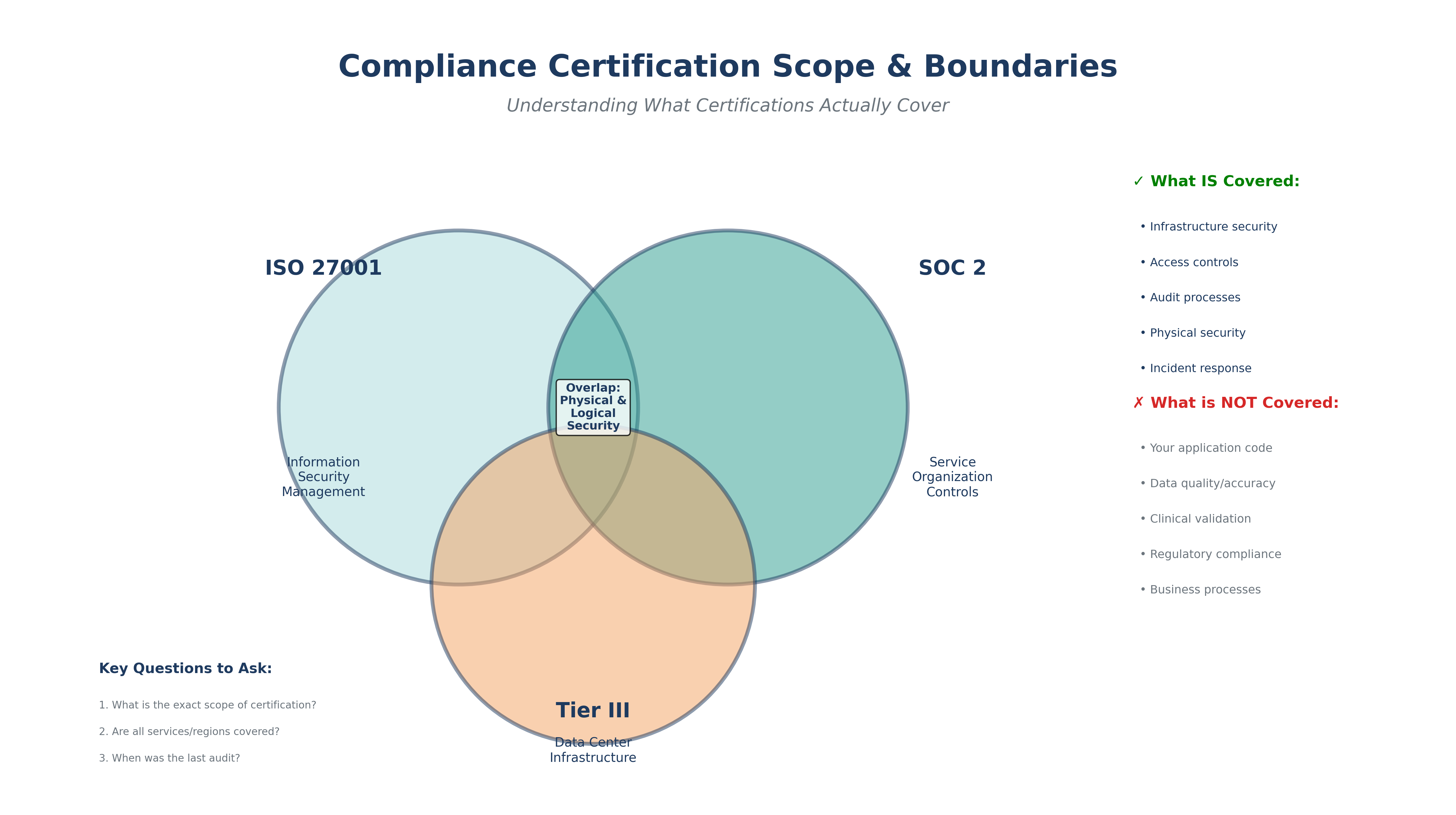
- ISO/IEC 27001: Information Security Management Systems International standard defining requirements for establishing, implementing, and maintaining an ISMS.
- Uptime Institute: Data Centre Tier Classification Defines Tier III as concurrently maintainable with redundant components and distribution paths.
- AICPA: SOC 2 — Trust Services Criteria Defines SOC 2 as a report on controls relevant to security, availability, processing integrity, confidentiality, and privacy.
- Hidden Technical Debt in Machine Learning Systems Explains why "buying a platform" can be lower-risk than building ad hoc — dependency drift, tool sprawl, and ownership gaps.