MLOps Is Not DevOps for Data Scientists
The term "MLOps" is often introduced as the natural extension of DevOps practices into machine learning. In unregulated contexts, that framing works well enough: continuous integration for training code, automated testing for model performance, and streamlined deployment pipelines. But in regulated R&D environments—pharmaceutical development, clinical diagnostics, GxP manufacturing—the analogy breaks down almost immediately.
In a regulated context, MLOps is fundamentally about three things: repeatability, control, and traceability. The goal is not faster iteration for its own sake. The goal is the ability to reconstruct exactly how a model was produced, what data it consumed, what parameters governed training, and who approved its promotion to a production-grade artefact. Speed matters, but it is a secondary concern. Defensibility is primary.
The real question is not "can we deploy faster?" but "can we prove what we deployed, and why?"
This distinction has practical consequences. Teams that adopt MLOps tooling without first establishing their traceability requirements tend to accumulate complexity rather than reduce it. They end up with powerful tools that produce outputs no auditor can follow.
The Workflow Spine
Rather than starting with a tool catalogue, regulated teams should start with what we call the workflow spine—the minimum set of connected capabilities that make model development auditable from inception to deployment. The spine consists of four stages:
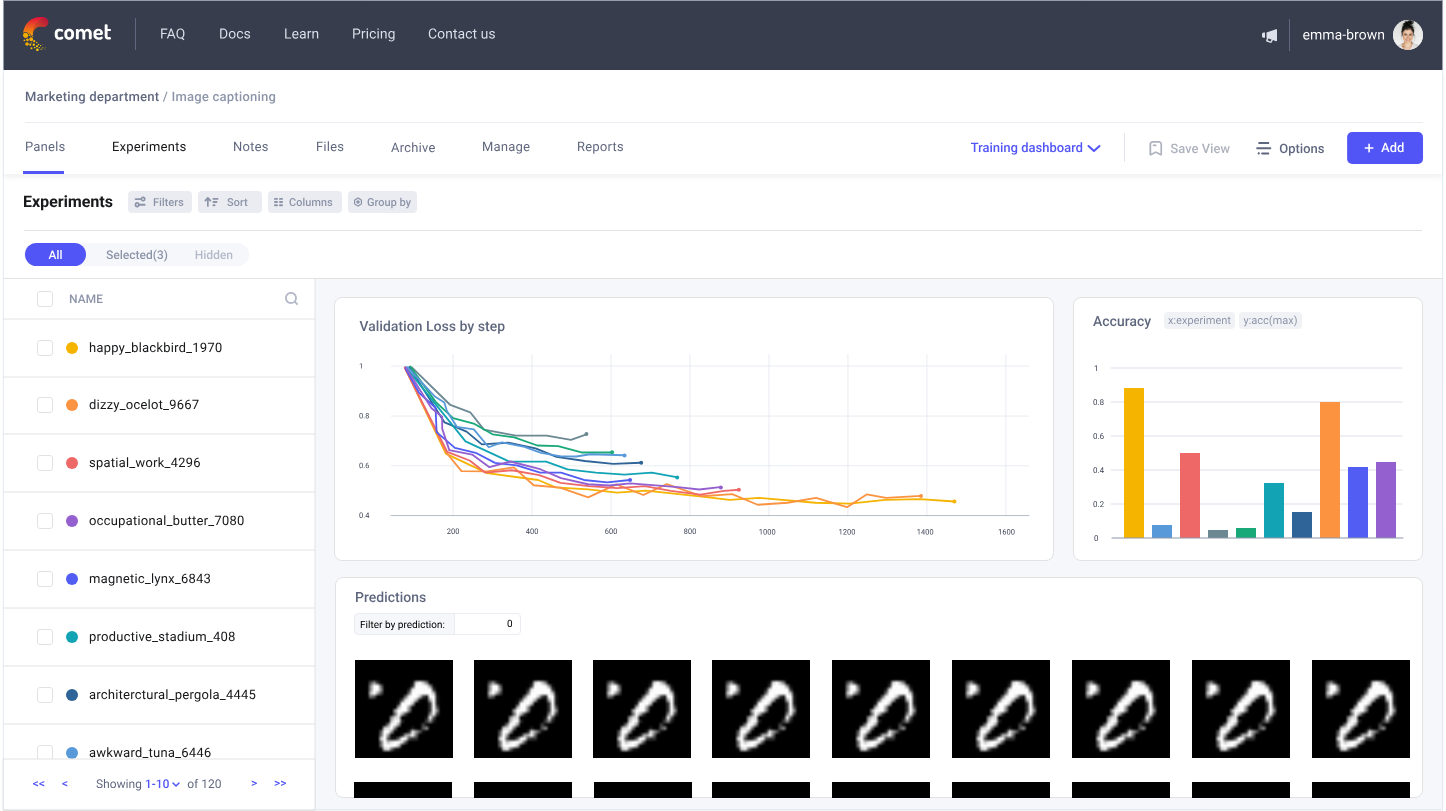
- Experiment Tracking — Capturing every training run with its parameters, metrics, code version, and data references. This is the raw evidence layer.
- Artefact Store — Persisting model binaries, serialised pipelines, and associated metadata in an immutable, versioned repository. Artefacts must be retrievable by lineage, not just by name.
- Model Registry — A governance layer that records model versions, their validation status, and promotion history. The registry is where "experiment output" becomes "controlled artefact."
- Controlled Deployment — Moving a registered model into a serving environment through an explicit, approval-gated process. No ad-hoc deployments. No manual copies.
Each stage feeds the next. The spine is not a suggestion; it is the minimum viable infrastructure for any organisation that must answer the question: "Show me the provenance of this prediction."
What Metadata Must Be Captured
Traceability is only as good as the metadata you collect. For regulated environments, the following categories are non-negotiable:
Parameters and Hyperparameters
Every training run must record its full configuration: learning rates, batch sizes, regularisation terms, architectural choices, random seeds. These must be stored in a structured, queryable format—not buried in log files.
Code Version
The exact commit hash of the training code, including any library dependencies and their versions. Reproducibility requires knowing not just what code ran, but the precise state of all code that ran. Pinned dependency manifests (such as lock files) are essential.
Data Pointers
References to the exact datasets used for training and validation, including version identifiers or content hashes. Data drift is one of the most common sources of model degradation, and without data provenance, diagnosing it is guesswork.
Environment Specification
Container image digests, hardware specifications, and runtime configurations. Two identical training scripts can produce different results on different hardware or with different floating-point implementations. The environment is part of the experiment.
Outcome Metrics
Accuracy, loss, AUC, F1, or domain-specific metrics—recorded at each evaluation step, not just at the end of training. Trend data matters for understanding model behaviour during development.
Mapping to Platform Tiers
The workflow spine maps directly to the platform tier architecture we have described elsewhere:
| Platform Tier | Workflow Spine Stage | Capability |
|---|---|---|
| P-01: Core Compute | Foundation | Secure, reproducible compute environments with GPU scheduling and resource isolation |
| P-02: Research Platform | Tracking + Artefact Store | Experiment tracking, versioned storage, notebook environments with lineage capture |
| P-03: Workflow Engine | Registry + Deployment | Model registry, pipeline orchestration, approval gates, controlled serving |
| P-04: Compliance Layer | Governance Overlay | Audit trails, access controls, retention policies, regulatory reporting |
This mapping matters because it provides a natural adoption sequence. Teams do not need to implement all four tiers simultaneously. They can begin with P-01 and P-02, establishing tracking and artefact storage, and progressively layer governance as their models move toward production use.
Regulatory Expectations
Two regulatory frameworks are particularly relevant to ML model lifecycle management in life sciences:
EU Annex 11 (Computerised Systems)
Annex 11 expects that computerised systems used in GxP contexts have traceable requirements, validated performance, and controlled change management. For ML systems, this means that model changes—whether to training code, data, or hyperparameters—must be documented and justified. The workflow spine provides the infrastructure to satisfy these expectations without manual documentation overhead.
FDA 21 CFR Part 11 (Electronic Records)
Part 11 is concerned with the trustworthiness of electronic records and electronic signatures. In the context of ML, this means that experiment logs, model artefacts, and deployment approvals must be tamper-evident, attributable to specific individuals, and retained for the required period. Immutable artefact stores and signed approval workflows directly address these requirements.
Annex 11 asks: "Can you trace the requirements and changes?" Part 11 asks: "Can you trust the records?" The workflow spine answers both.
The Cost of Tool Sprawl
One of the most persistent risks in MLOps adoption is tool sprawl—the proliferation of disconnected tools, each solving one part of the problem but collectively creating hidden technical debt. The concept was articulated clearly in the well-known Google research paper on technical debt in machine learning systems: the ML code itself is often a small fraction of the total system, surrounded by configuration, data management, serving infrastructure, and monitoring glue code.
In regulated environments, tool sprawl is more than an engineering nuisance. It creates compliance gaps. When experiment metadata lives in one system, model artefacts in another, and deployment records in a third, the ability to produce a coherent audit trail depends on fragile integrations and manual reconciliation. Every seam between tools is a potential point of failure during an inspection.
The antidote is not necessarily fewer tools, but a coherent spine that connects them. If your tracking system, artefact store, registry, and deployment mechanism share a common identity model and lineage graph, the number of underlying tools matters less. What matters is that any artefact can be traced back to its origin in a single, unbroken chain.
Practical Signs of Hidden Debt
- Model artefacts that cannot be linked to the exact training run that produced them
- Deployment records that reference model versions without corresponding validation evidence
- Experiment logs stored in formats that are not machine-readable or queryable
- Environment specifications that are implicit (e.g., "whatever was on the GPU server") rather than explicit
- Manual steps in the promotion workflow that bypass the registry
Start with the workflow spine, not the tool catalogue. Define the minimum chain of evidence your organisation needs—from experiment to deployment—and select tools that reinforce that chain. Every tool you add should make traceability easier, not harder. If it does not connect to the spine, it is adding debt, not capability.
Where to Begin
For teams that have not yet formalised their ML workflows, the most effective starting point is experiment tracking with structured metadata capture. This single capability—recording what was run, with what data, producing what result—creates the foundation for everything else. It is low-cost, low-risk, and immediately valuable for both scientific and compliance purposes.
From there, the progression is natural: versioned artefact storage, then a model registry with controlled promotion, then gated deployment. Each step adds governance without disrupting existing scientific workflows. The key is to treat traceability as the primary design constraint, not an afterthought bolted on once the tooling is in place.
The organisations that succeed at MLOps in regulated environments are not the ones with the most sophisticated toolchains. They are the ones that can answer a simple question at any point in their model lifecycle: "How did we get here, and can we prove it?"
References & Further Reading
- MLflow Model Registry Documentation Model registry concepts including lineage tracking, versioning, metadata management, and controlled model promotion.
- Kubeflow Pipelines: Pipeline Concepts Pipeline definition as directed graphs of components with explicit parameter and data flow in Kubernetes environments.
- Hidden Technical Debt in Machine Learning Systems NeurIPS paper explaining why ML systems accrue hidden maintenance costs and the business case for platformisation.
- Model Cards for Model Reporting Structured documentation approach for models — practical governance artefacts for transparency and accountability.
- NIST AI Risk Management Framework 1.0 Organisational framework for managing AI risks — useful governance language for Tier 04 compliance narrative.